FNA’s Amendment 3 Messaging Toolkit Now Available
This November, Florida voters will decide on Amendment 3, a proposed constitutional amendment that would increase the homestead exemption to $250,000 by 2028. If passed, the property tax revenue available to local governments would be significantly reduced, possibly affecting funding for public services and community resources across the state.
Florida nonprofits shared their concerns about what those changes could mean for the sector in a survey conducted by FNA in July. Organizations reported that local government funding and partnerships play a vital role in supporting their work and that reductions in that support would affect services ranging from homelessness prevention, disability services, and mental health care to after-school programs, arts and cultural programming, and animal welfare.
Those consequences can be difficult to communicate when the impacts to local government revenue can sound abstract, particularly for voters who are weighing it against the more immediate promise of property tax relief.
To help. Florida Nonprofit Alliance has launched the Amendment 3 Messaging Toolkit. This collection of messaging and communications resources is designed for nonprofits seeking to educate their communities on the property tax issue and engage voters ahead of the November election.
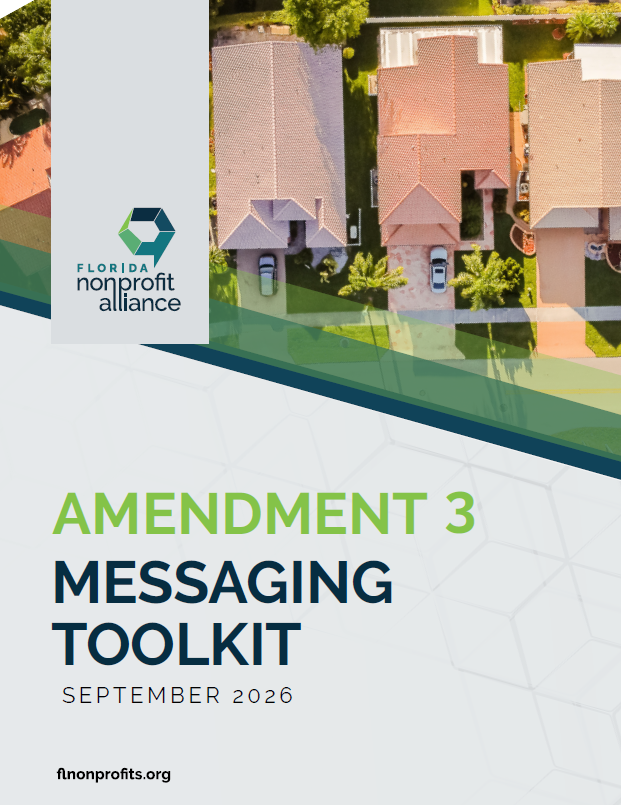
AMENDMENT 3 MESSAGING TOOLKIT
Nonprofits have an important role to play in helping Floridians understand what Amendment 3 could mean for their communities. The Amendment 3 Messaging Toolkit gives leaders a common foundation for communicating about the issue while providing the flexibility to make the message relevant to their mission.
Download
Included in the toolkit is:
- A Messaging Framework that provides the foundation for the toolkit, with a core message and three supporting message pillars focused on fewer services, growing need, and impacts communities could feel quickly. It also includes guidance on language to use and avoid, and sample conversations for clients, board members, community members and funders.
- The Communications Strategy helps organizations put that messaging into action. It identifies priority audiences and provides guidance on voter engagement, paid advertising and earned media campaigns.
- An Op-Ed Template gives nonprofit leaders a customizeable starting point for elevating their voice and bringing their perspective to local media, connecting the impacts of Amendment 3 to their community and the services their organizations provide.
- A collection of Social Media Templates, with ready-to-use graphics, illustrating the potential effects of Amendment 3, is also included. You are encouraged to use these templates as a starting point and to personalize them with local information and trusted community voices.
Spanish and Haitian Creole translations of the Amendment 3 Messaging Toolkit resources can be found here.
The toolkit is intended to serve as a foundation for your messaging strategy that can be adapted to include impacts relevant to your organization and its key audiences. Nonprofits are trusted experts in their communities and the people they serve. Framing those experiences can help make the potential effects of Amendment 3 more tangible for Floridians.
On September 15, FNA will host Activating the Amendment 3 Messaging Toolkit, a one-hour webinar designed to walk participants through the toolkit and provide guidance on adapting these resources for different audiences. This event is free and open to all. To register, click here.
To learn more, about Amendment 3, visit FNA's Property Tax Resource Center.